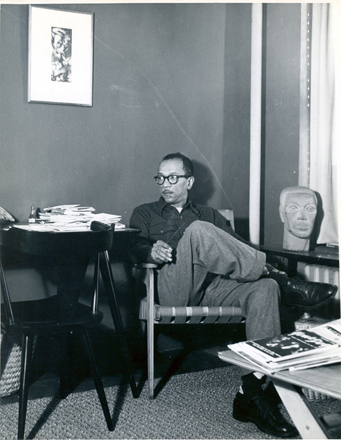
Black artists that came of age in the 1940’s formed a tight network of trailblazers, visionaries, influencers and connectors. When I think of the legendary Charles White I see a connector. Nearly every black artist that created art between the 1940’s and 1980’s were influenced in some way by Charles White. His guidance and advocacy ignited the careers of many artists.
As a young artist in Chicago he used his talent to gain access to groups and guilds that fostered community and networks of supporters. After fighting in WWII and living in New York and Mexico, White remarried and moved to Los Angeles in 1950 where he would paint, draw, teach, and become a leader in many of the artist associations that organized black artists through the 1960’s and 1970s. During this time his artistic practice shifted from painting to drawing, a time when many of his most notable works were created.
Charles White, Seed of Love, 1969. Photo Credit: LACMA
Charles White maintained an extensive diverse network with connections to Hollywood entertainers, musicians, writers, intellectuals and scholars where these relationships fostered numerous collaborations. As mentioned in a previous post about Ruth Waddy, Charles White accompanied Waddy and Norman Houston in a failed attempt to bring a juried show to LACMA, however in 1976 White was one of 63 artists shown in LACMA’s first comprehensive group show called “Two Centuries of Black American Art, 1976”. White’s contribution called Seed of Love is a striking work that conveys a dark lush background that plays off this beautiful ray light that refuses to be enveloped by the rich darkness surrounding the painting. The light shines down on an expectant mother in an flowing white slumber gown. The proportions of the mother’s enlarged hands and a low belly enveloped by her oversized gown convey the power and strength of motherhood.
White’s passion for the arts and his desire to make his art accessible to many, echoed his dedication to social justice and equality. His advocacy and role in fostering an artistic community struggling to be recognized and respected sybolically mirrors the nurturing mother in Seed of Love. White demonstrated a protective reverance for the black art community in ways that continue to resonate today. His advocacy, rooted in the strength of his diverse network placed an important spotlight on black artists who were fighting for the attention of museums and the art world at large.
Additional Resources:
Beauty, Truth and Reality through the Art of Charles White http://www.cejjesinstitute.org/cwpp/index.php


 Colony Little, Culture Shock Art
Leave a comment