


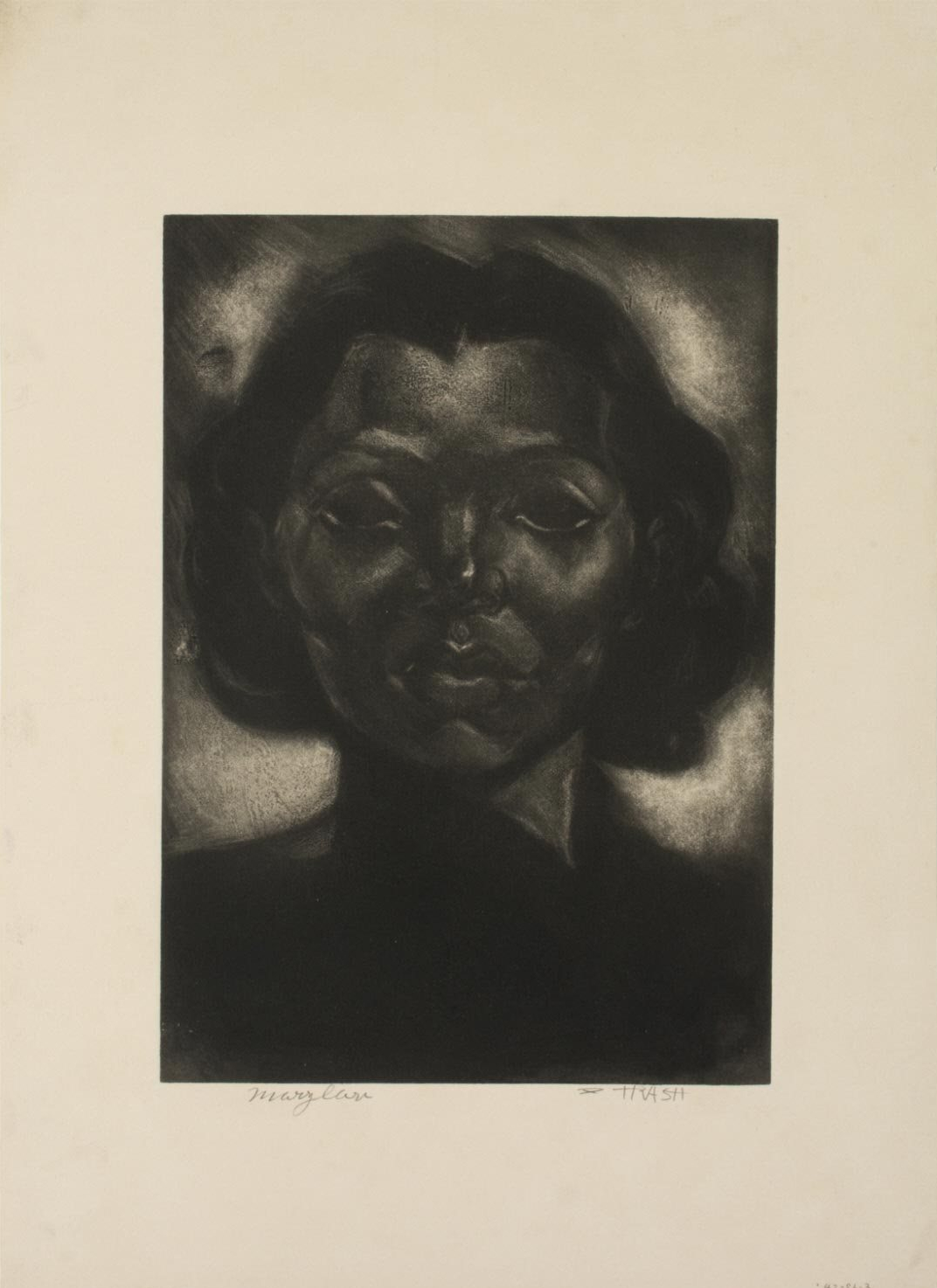
Dox Thrash (1893-1965) grew up in Georgia in the early 1900s with a childhood love for art that would lead him toward self-study of the practice through correspondence courses. His goal was to attend an art school that admitted Black students and the Great Migration led Thrash to Chicago where he studied at the Art Institute before being enlisted in the Army during WWI. He would later settle in Philadelphia where he built his artistic career as a draftsman, becoming a master printmaker and the first Black artist in the Fine Print Workshop of Philadelphia as part of the Works Progress Administration. Through his work with the workshop, he pioneered the carborundum printing process, a unique form of lithography which takes particles of carborundum that are applied to a plate to create tone. His carborundum mezzotints feature a broad range of mid-tones that are beautifully suited to highlight dark skin tones, shadow and light in emotionally evocative portraits and melancholic landscapes that harken back to Thrash’s formative years in Georgia.
While his mezzotints became his most notable and popular prints, he also worked in other mediums including watercolor, aquatint and traditional etching. I was drawn to a piece appropriately titled Saturday Night, and I loved how scholar Kymberly Pinder describes the woman in the work:

“As the title suggests, the young black woman in Saturday Night is pressing her hair with a heated comb in preparation for an evening out. The empty chair in front of her may have been recently vacated by her last customer or by a family member whose hair she had coifed in her kitchen. The long and arduous task of making coarse, tightly coiled hair straight to mimic current white hairstyles was often a communal event during which women gossiped and entertained. Those who were efficient and good at it could earn some extra income. Now, past midnight, this hairdresser has turned to herself, a bit weary but not too tired to hit the town.”
Here’s to Saturday night.


 Colony Little, Culture Shock Art
Leave a comment